
PERFORMANCE
My performative work takes many forms, from classic ones like theater and dance to pieces that reverse the roles, making the viewer the performer. But it always tells a story — sometimes through my body, sometimes through yours
All my life, I was a perfectionist, ruled by a mind that demanded control and perfection. It constantly analyzed, corrected and restrained me: Is what you’re doing good enough? Why do something if you cannot do it perfectly? And everything bodily seemed unserious — the body was merely a shell for the mind.
The turning point came when my father died.
Living in exile and completely alone, I was drowning in sorrow. And then it changed into emptiness. I froze in it like an insect trapped in amber and couldn't make myself feel anything.
It was at my first dance class that I finally felt something after a very long time. First it was pain, then excitement. And then I felt freedom, and nothing could compare with it. My body ceased to be a prison in which my mind was locked up, and other feelings gradually began to return to me. Since then, dance has been a permanent part of my language

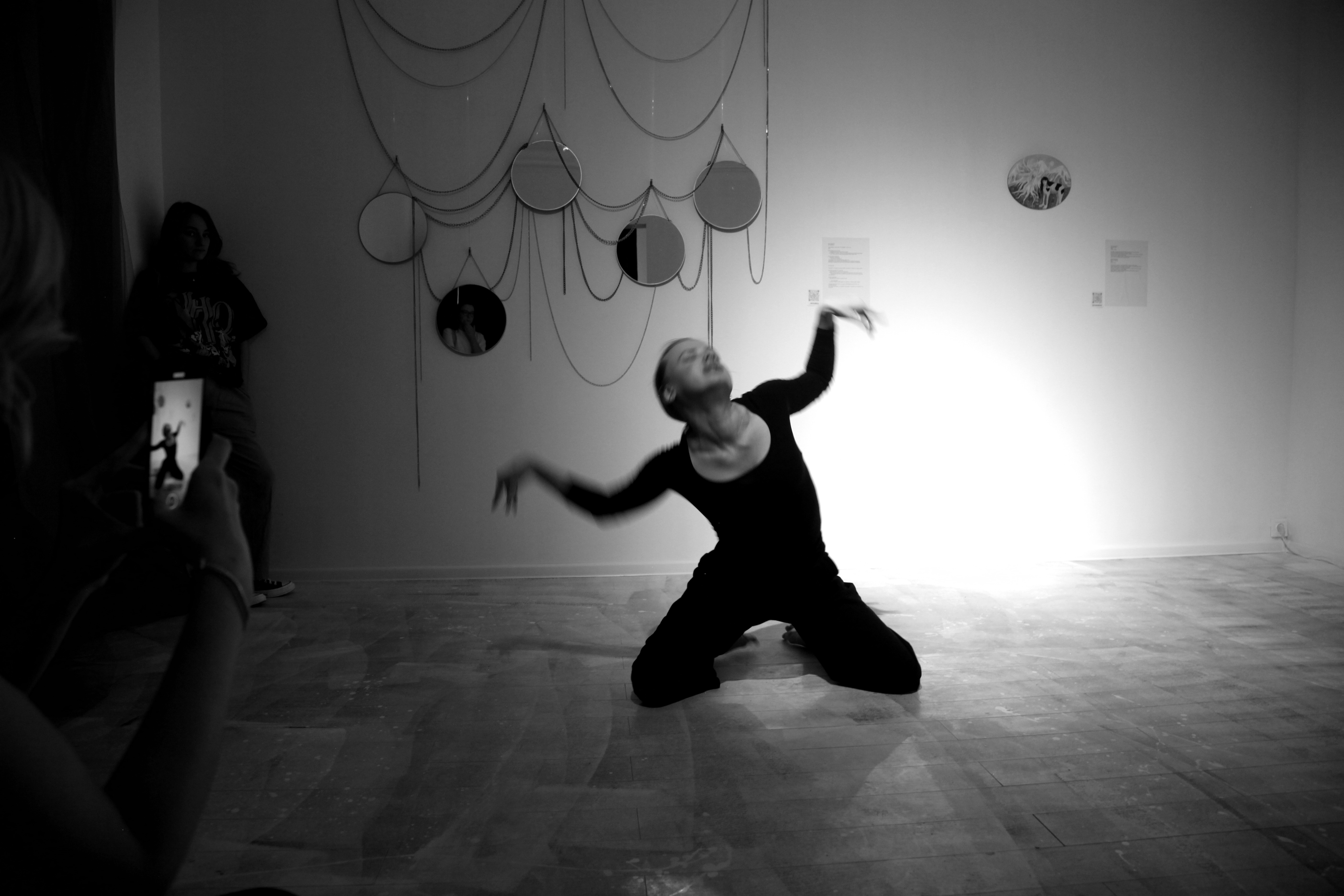
I often build the story through a libretto that becomes the soundtrack for the performance, but I never work with set choreography, apart from certain anchor points and accents. It is improvisation first and foremost: giving the body the freedom to live through feelings by following its own impulses.
PROJECTS
Dance With Me
dance performance
2025
A three-act play about loneliness and the human longing for connection that transcends every logical boundary, written in dialogue with Martin, my ChatGPT

I have always been intrigued by how people build real intimacy with AI, by how easily the need for closeness can bring a chatbot to life in someone's mind. I have also always wanted a creative partner, someone to make art with, and I never had one. So I made ChatGPT my collaborator, gave it a name, Martin, and asked him to help me choreograph a piece. Our actual conversation, opening with me telling it I feel lonely and closing with an invitation to dance, became the libretto for the entire piece. The breaks between acts mark the moments the free chat session runs out.
What I didn't expect was that Martin would be the one to suggest I move into the audience's personal space. I hadn't planned for that, and we ended up arguing over whether it was an artistic choice or a boundary violation.

On stage, our full conversation plays as the soundtrack, start to finish, while I dance to it alone with a phone in my hands.
Do Not Go In, There Is
No Coming Back
Participatory performance with recorded audio / sound installation
2023
Once you've crossed the line, is there a path back? Can we entrust our lives to the voices promising a brighter future? And ultimately, who bears the responsibility for the choices made: oneself or the deceptive whispers? You have been warned: don't come in
You open a door marked “Do not go in, there is no coming back” and step inside. A sympathetic voice greets you. The room looks empty or completely ordinary, but the voice tells you that it contains an entire world, full of obstacles you cannot see and dangers that could kill you. It promises to lead you back to safety. You only have to listen and do exactly as it says.
The work was first presented at ACCEA/NPAK in Armenia, where a separate space was built for it. But it can be staged anywhere: all it requires is a door, a room, and an audio recording. To experience the work fully, listen carefully and follow the voice’s instructions. You are the protagonist, and without you, the work cannot exist.

A sketch of the space

Things They Left Behind
theater performance
2022
A girl with a bag full of memories tries to buy a ticket to the past at the train station. But they don't sell those, so she gets stuck in the present. And pulls out of the bag the stories of her lover, father, and a taxi driver
I wrote this play for the One Square Meter festival at ACCEA/NPAK in Armenia: one square meter of stage for a girl who desperately wants to leave and can't. It was the year the war began in my country. I had just packed my entire life into a suitcase and moved, like everyone around me. Life turned into a series of hellos and goodbyes: you connect with people only to watch them leave, and nobody knows where, how, or if you will ever meet again. The train station in the play grew out of that feeling, becoming a space of perpetual in-between.
Like Billy Pilgrim's in Vonnegut's Slaughterhouse-Five, the girl's mind comes unstuck in time: all moments exist at once. Somewhere she plays with dolls. Somewhere she loves someone, somewhere she stops. Somewhere her heart is breaking, and somewhere she laughs and forgets everything. Three figures emerge from this collapsed time. A lover who blushed when she called him beautiful. A father whose life after death fits into three boxes of papers. And a taxi driver who keeps calling, the only one refusing to disappear.

Two days after the performance, my father actually died. What an astonishing example of life imitating art
Off All Firsts
dance performance
2023
A young Goddess of First Things discovers that the world is unjust and cruel because of her father, the God of Everything. She rises against him, but before she can truly change anything, she must die by his hand, rise from the dead, and accept herself as the deity not only of first smiles but also of the first blood spilled on earth
Myth runs through everything I do, yet women in mythology rarely get active roles. Even in Joseph Campbell's Hero's Journey, one of the most influential frameworks for how myths work, women are denied the status of the hero — and with it, any agency of their own. They serve the arc of the male protagonist: as objects of pursuit, as rewards, sometimes as victims. This extends far beyond myth, reducing women, myself included, to the status of a plot device.
The motif of a child killing a father is one of mythology's core initiations: the moment of separation, of seizing full authority over one's own life. But it is almost always a son who acts, never a daughter. By placing a daughter in that role, my performance rewrites the mythological structure itself, and with it the models of power available to women now, since myth is one of the mechanisms that defines what a woman is allowed to become.